2004 was truly a banner year for anime. While classic and beloved series like Naruto, One Piece, and Bleach continued their dizzying ascent, new series such as Paranoia Agent and Monster were pushing the medium forward in new and interesting ways.
21 years after the fact, however, one 2004 anime stands above the rest for its subversive take on Japan’s most famous and iconic genre of story. While tales of noble samurai might be popular, Samurai Champlootakes a wrecking ball to the entire concept.
Samurai Champloo Deconstructs The Entire Concept Of Samurai Stories
While some of the best samurai anime portray the fighters as honor-bound warriors who follow very specific ethical frameworks, Samurai Champloo takes a far less romantic few of the profession.
Taking place in the late Edo Period of Japanese history, Samurai Champloo follows a young woman named Fuu who ropes two wandering fighters into helping her locate her father, the sunflower samurai.
The two fighters accompanying Fuu, Mugen and Jin, couldn’t be any more different. Jin is far closer to the classic image of a samurai, being generally quite honorable and straightforward, whereas Mugen is reckless and chaotic.
During their adventures through Japan, Fuu, Mugen, and Jin are forced to fight a wide variety of samurai who, for various reasons, are out to kill the main trio of heroes.
What’s notable about the series’ villains, however, is how they subvert classic images of samurai. Far from noble warriors, the wandering ronin featured in Samurai Champloo are more like enforcers for organized crime organizations than anything else.
Samurai Champloo Is About Japan In Transition
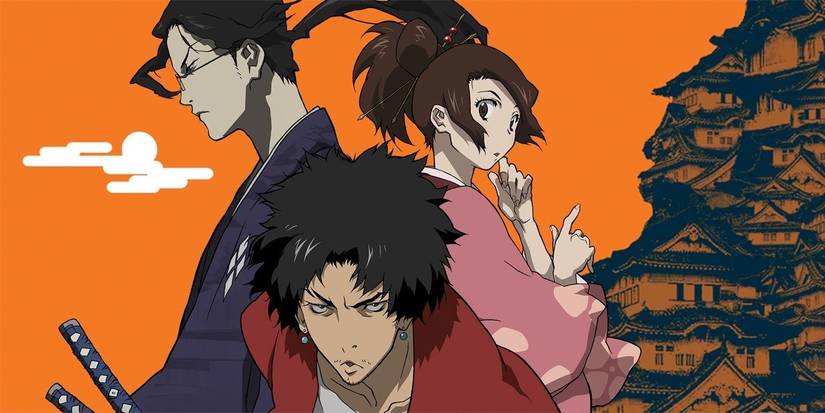
Despite the abundant anachronisms practically bursting out of every corner of Samurai Champloo, the series is very much about the time period it is set in. Japan’s late Edo Period was a great time of transition for the nation as the influence of Western powers grew and the era of feudalism was on its way out.
To convey the cultural chaos of the time period, Champloo makes frequent use of objects, concepts, and dialogue that would have been out of place for the time period the series is set in. The hip-hop soundtrack is the most obvious example of this.
The score, composed by hip-hop luminaries Shinji “Tsutchie” Tsuchida, Fat Jon, Nujabes, and Force of Nature, gives the series a thoughtful air that is still unrivaled, ensuring it has one of the best anime soundtracks of all time. The music featured in Samurai Champloo was so ahead of its time that it is still a major influence on the recent explosion in popularity of lo-fi hip-hop.
The cumulative effect of both the music and the other temporally dubious elements, such as Jin’s glasses, is a sort of disorientation that reflects the clashing of eras seen in the real-world time period.
More specifically, this is the world that samurai found themselves in during 19th-century Japan. The waning power of feudalism, combined with an unusually long era of peace, meant that there was little place or need for the once ubiquitous samurai.
The real death-knell for the samurai would come with 1868’s Meiji Restoration, which was an attempt by the nation to modernize its society. While Samurai Champloo almost certainly takes place before the Meiji Restoration, the tension of this massive change to come is palpable.
Despite Being Set In The Past, Samurai Champloo Is Forward Looking

Given that Samurai Champloo is, quite literally in places, about the dying of an era, one might expect to find some romanticization of a Japan that is long gone, but that couldn’t be farther from the truth.
More than just the samurai being corrupt, in Samurai Champloo, it is the entire structure of Japanese society that is the problem. One of the main characters, Mugen, is notably from the Ryukyu Islands. As Mugen’s story in Champloo points out, people from the Ryukyu Islands often face discrimination in Japanese society, as do the native Ainu people.
While there is undeniably some beauty to be found in the era, Champloo is quick to point out the structural inequalities and injustices that define the period. While Champloo is a diverse anime featuring a cast of characters with a wide set of beliefs and backgrounds, it’s clear that the cast exists despite an oppressive ruling class that wants only conformity.
Samurai Champloo Is The Bridge Between the Works Of An Acclaimed Creator

Samurai Champloo was created by Cowboy Bebop showrunner Shinichiro Watanabe. Though Champloo has often been called the spiritual successor to Bebop, the two series differ in many areas and end up with exact opposite central themes.
Cowboy Bebop, despite being set in the future, is very much about people trapped in the past. This is reinforced with the Bebop’s famously jazzy soundtrack and the antiquated technology present throughout the series. It’s not just Spike and his companions that can’t escape their past; it’s the whole solar system.
In contrast, the cast of Samurai Champloo can’t help but look forward. These are characters who are ready for the next stage in their lives, and in the world but are constantly confronted with reminders of what came before. Much like Bebop, this is reinforced through the soundtrack and technology present.
It’s so clear, throughout Champloo, that the new world is ready to be born and that the old world is ultimately what’s holding it back.
There is a reason Bebop famously ends with the death of its protagonist, while Champloo ends with all three of its heroes living despite the tremendous odds against them.
Given all the clear thought and effort that went into Samurai Champloo from Watanabe and the staff at Manglobe, it’s a shame that the anime always seems to live in the shadow of Bebop. While the two works do share much in common, Champloo stands on its own as a titanic effort.
Samurai are one of the most iconic elements of Japanese history, so seeing an acclaimed creator make a work so openly critical of them is truly a marvel. Watanabe doesn’t pull his punches with Japanese history in Samurai Champloo, and that’s why, even 20 years later, it still holds up as the best anime of 2004.

- Release Date
-
2004 – 2005
- Directors
-
Shinichirô Watanabe
- Writers
-
Masaru Gotsubo
- Franchise(s)
-
Samurai Champloo