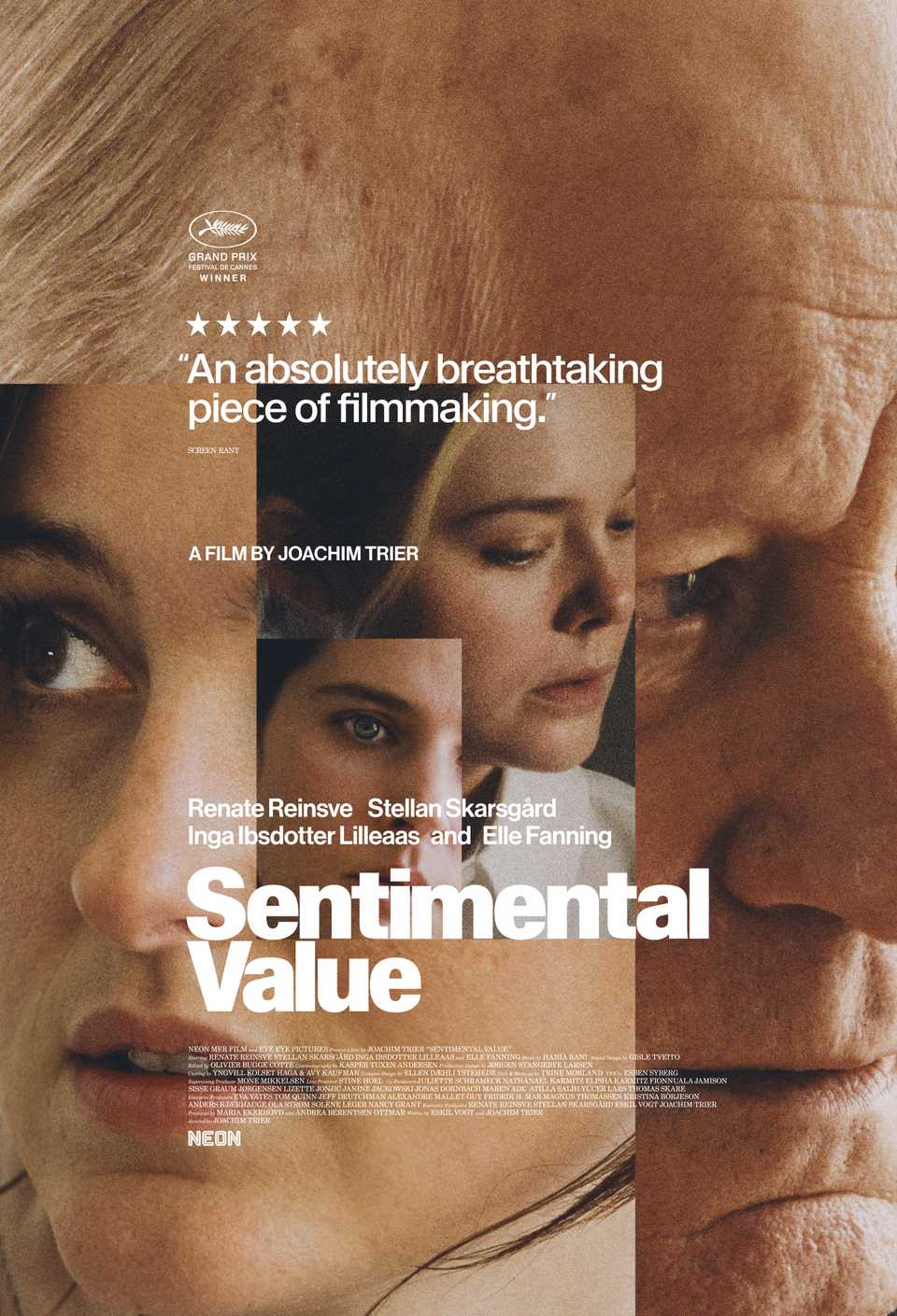
If there’s one thing Hollywood loves, it’s movies about itself. From Singin’ in the Rain to Babylon, the epic highs and lows of being a creative in the filmmaking industry are ripe for their own stories. When it comes to the latter, this fall has provided two new titles that take vastly different approaches to the same theme. The first, Joachim Trier‘s festival darling Sentimental Value, explores the fractured relationships within a Norwegian family, where the absent father is a famous film director who is estranged from his two daughters, one of whom is a stage actress.
On the other end of the spectrum, Noah Baumbach‘s latest Netflix release, Jay Kelly, finds the titular actor (played by George Clooney in a rather meta position) looking back on his life and questioning the impact his career has had on his personal relationships. Both movies are in the awards conversation this year, with Sentimental Value so far gaining the upper hand. That isn’t too much of a surprise considering how, in the discussion about the pitfalls of being a celebrity, Trier’s approach is far more of an achievement.
‘Jay Kelly’s Take on Hollywood Is Blunt and Generic Compared to ‘Sentimental Value’s Unique Characters
From the very beginning of Jay Kelly, the audience is told that Clooney’s character is a star of the highest order. His presence is felt even before he appears onscreen, with the camera traveling over a cavernous soundstage to emphasize the breadth of the production Jay’s leading. The real Jay Kelly is only glimpsed briefly before he’s sinking into his character; viewers first meet him on the job, which has defined his entire life. From there, Baumbach makes short work of establishing the key facets of Jay, which is that he’s a busy, successful actor; his closest relationship is with his manager, Ron (Adam Sandler); and he’s distanced from his daughters.
Even if all this wasn’t demonstrated through the initial scenes of Jay interacting with his youngest, Daisy (Grace Edwards), the dialogue hammers it home, frequently. There’s little nuance to Jay’s story, since everyone from his publicist (Laura Dern) to his oldest child (Riley Keough) will outright discuss the details. When the actor impulsively jets off to Europe in a desperate attempt to connect with Daisy, he brings along his whole entourage and has an assistant tracking her. Their presence alone makes his out-of-touch sensibilities clear, but the movie itself comments on it through the characters as well.
These 9 Movie Masterpieces of 2025 Will Be Classics in 10 Years
Movies that are gonna be, gonna be golden.
Beyond that, though, Jay Kelly‘s version of celebrity plays like a stereotype. The arc of an actor who pursues fame and success over his friends and family isn’t exactly revolutionary, and the film does little to advance it. This isn’t to say there’s no emotional heft at all; in fact, the ending of Jay Kelly is quite moving, and Clooney really sells his character’s regrets and hurts. However, when put alongside Sentimental Value, Baumbach’s movie feels like one that viewers have seen before.
Jay’s arc could apply to several characters, while the characters of Sentimental Value feel exclusive to their specific circumstances. Nora (Renate Reinsve), Gustav (Stellan Skarsgård), and Agnes (Inga Ibsdotter Lilleaas) are rooted in their backstories and surroundings, which can’t quite be replicated in a different font. The way that fame has impacted their relationships is unique to them, not a broad archetype held up by other familiar plot points.
‘Sentimental Value’ Cuts Deep in the Present As ‘Jay Kelly’ Gets Lost in the Past
Sentimental Value‘s drama begins when Gustav, who has long put his career over his family, asks Nora to star in his latest film, a deeply personal project he wishes to shoot at their family home. For Nora, an actress who gives her all to her theatrical performances but also suffers from crippling stage fright, it’s an offensive request, seeing as Gustav has spent so little time caring about the art she creates. She’s also seen firsthand what it means to work with him, since Agnes starred in one of his movies as a child; one of Sentimental Value‘s most gutting moments is when Agnes tearfully lays into Gustav for that time, which she loved so much, even though it ultimately broke her heart when he largely ignored her after.
The true strength of Sentimental Value‘s story — the reason why it’s so emotionally resonant — is because it centers on the specific familial dynamics, and the impact of fame is layered on top of it as added texture. Gustav and Nora’s relationship is strained because of the former’s devotion to his work, but underneath that, they’re remarkably similar people. They discuss their projects the same way, they laugh at the same jokes, and they both carry deep hurts inside them. As they navigate the minefield that is their work, they’re forced to reckon with that.
This is also where Sentimental Value gains the upper hand over Jay Kelly. Though it is interspersed with glimpses of the past, going as far back as Gustav’s mother, Sentimental Value largely plays out in the present. The characters are stuck processing and acknowledging how the past has hurt them, and the ending leaves them with a hopeful path forward. Conversely, Jay Kelly sends its protagonist back through his own memories, watching him watch key moments from his life. For a nostalgic character study, it works, but it also leaves the supporting figures of Jay’s life feeling flimsy as personalities that shaped him. It isn’t quite as introspective as it seems.
Both Sentimental Value and Jay Kelly mine real heart from the question of what kind of toll being a celebrity takes on a person, but the former makes a stronger impression. In reckoning with the present and the characters’ long-standing relationships, Sentimental Value feels urgent and unique, whereas Jay Kelly‘s more heavy-handed approach is too familiar to stand out. It can’t quite match the towering presence of its own lead character.
Sentimental Value is now playing in theaters in the U.S.
- Release Date
-
November 7, 2025
- Runtime
-
132 Minutes
- Director
-
Joachim Trier
- Writers
-
Eskil Vogt, Joachim Trier
- Producers
-
Nathanaël Karmitz, Maria Ekerhovd, Elisha Karmitz, Andrea Berentsen Ottmar
-

-
Inga Ibsdotter Lilleaas
Agnes