An institution and genre of movies and television unto himself, Ken Burnshas been a mainstay in documentary filmmaking for over 40 years. His body of work is vast, but it still can’t keep up with the broad scope of American history. The filmmaker who chronicled the history of American staples like baseball and jazz music is going back to the founding of the country with his latest masterwork, The American Revolution, about the titular conflict that gave birth to the United States after separating from Great Britain’s colonial control.
It’s such a seminal moment in American and world history that it’s surprising Burns never dove head-first into the subject until now, but with evolution, newfound perspectives, and a seasoned filmmaker, there is no better time to revisit the Revolutionary War than in 2025, a year that also brought another re-examination of the founding of America, Kevin Costner’s The West. The six-part PBS documentary series is a must-watch for everyone, as we can only learn about the present and future through the past.
Ken Burns’ ‘The American Revolution’ Is an Epic Treatise on the Founding of America
Running about 12 hours across its six episodes, The American Revolution, also directed by Sarah Botstein and David Schmidt, tracks the early days of colonial America in 1754 through 1780 and onward, with the crux centering around the signing of the Declaration of Independence and the battle for life, liberty, and the pursuit of happiness against Britain. Like all Burns projects, the series is a kaleidoscope narrative focusing on all facets of this groundbreaking period, everything from military generals and politicians to the marginalized Black slaves and Native Americans. Narrated by Peter Coyote, Burns assembled an all-star lineup to perform the voices of the historical figures, including Samuel L. Jackson, Claire Danes, Paul Giamatti (reprising his role as John Adams), Jeff Daniels, Morgan Freeman, Tom Hanks, Meryl Streep, and many more.
Although the series is overwhelmingly expansive and thoroughly researched, The American Revolution doesn’t waste time approaching its dense subject. A 12-hour documentary series should feel redundant, but Burns runs a concise ship, leaving room for the possibility of a director’s cut that dives into more research. The most vital and noteworthy inclusion in this finely tuned narrative is the focus on African Americans, predominantly in slave captivity at this time, and Native Americans, who were already a century into their own conflict over land with white settlers. These vital arcs, concurring alongside the American Revolution, form Burns’ triptych structure that sometimes feels bloated but is important to discuss nonetheless. The series deals with these groups with a nuanced eye, treating their plight and issues with the severity of the conflict between the U.S. and Britain, and maintaining a critical eye on the American side without engaging in overwrought hand-wringing.
Ken Burns Presents the History of America With Calculated Precision in ‘The American Revolution’
The American Revolution is a worthy comparison to Kevin Costner’s The Westor any documentary/narrative film about the American Frontier and the founding of the United States. Where the birth of most countries is abstract and hazy in its details, America has a clear origin story that is taught in early education. As a result, the initial political disputes over taxes and representation, leading to violent bloodshed on the American front, have become a legend passed down from generation to generation.
With countless buildings, streets, cities, and monuments named after the Founding Fathers, this period looms large over everyday life and especially the fabric of American government. As with any Western, fictional or nonfictional, the historical apparatus of the American Revolution glamorizes the colonial rebels as almighty heroes, but the truth is anything but black-and-white, and Burns underlines the complex nature of America’s origins with candid, unbiased direction, along with support from venerable historians serving as talking heads.
Stylistically, everything we’ve come to know and love about America’s premier documentarian is on full display in this epic series. Being a Ken Burns series, be prepared to experience the influential, evergreen “Ken Burns effect,” a slow zoom on a still photo that persists in all forms of video production. In The American Revolution, the calming aesthetic, gentle orchestral score, and meticulous attention to detail feel even more soothing than before. Although Burns’ formalism is proudly minimalist, the use of real locations and landmarks of pivotal events during this era gives an adventurous component to the docu-series. The only thing Burns loves more than picturesque landscapes is archival documents and other first-hand sources, which the camera scans with complete precision. Burns’ signature slow pan on images emphasizes that history was defined via pen and stationery.
‘The American Revolution’ Is a Timely Release That Reflects Our Political Climate
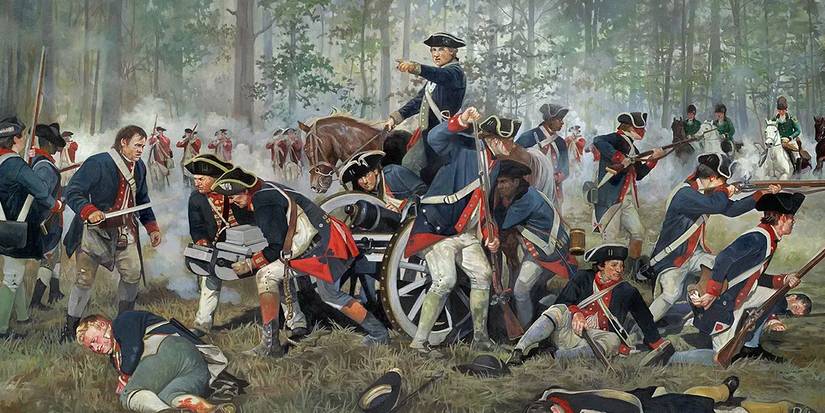
The American Revolution arrives on the public airwaves at a critical juncture in our lives. Lexington and Concord, Paul Revere‘s Midnight Ride, the Boston Tea Party, and the Continental Congress are all cherished iconography and represent the unification of all American people for the common good. However, the American people are anything but unified these days. Our understanding and reverence for the American Revolution were seemingly set in stone, but the last 10 years have proven that even the most frivolous matters can divide us. Burns, who favors an analytical approach over sentimentality, is the ideal mediator between two polarized sides in American culture. Rather than embellishing the myths, Burns presents the facts of this decades-long saga as if it weren’t the most studied and memorialized event in American history, but rather, a brand-new discovery. The director, who argues that America’s longing for sheer independence went beyond any political or social cause, re-shifts our perspective on the war.

This Gritty, Underrated Miniseries Proves the Western Genre Is Still Going Strong on TV
The brutal and bloody series follows a gripping tale of survival in the 1850s.
Being 250 years old, glorifying the Revolutionary War is likely more digestible in the public eye, as it isn’t burdened by the connotations of our current thorny political climate. Still, Burns refreshingly refuses to engage in any rah-rah jingoism on the American front, evidenced by his spotlighting of the perpetual mistreatment of Indigenous people and their participation in the slave trade. Even if Burns is politically distant in his narrative construction, the release of The American Revolution doesn’t feel like a coincidence, especially since many details sharply underline ironies about the war that would refute any romanticism from blind flag-wavers. Facts such as patriots tearing down statues, George Washington mandating a smallpox vaccine, and women posing as men to partake in combat speak directly to hot-button issues of today.
In the end, America, from its early days as 13 colonies to the present day, is a cyclical country. We’ve evolved greatly and remained stagnant simultaneously. Hopefully, Ken Burns’ latest epic documentary, The American Revolution, can clarify just how evergreen our ideals and values are, as well as reject the notion of generational divides. After all, we’re all fighting the same war.

- Release Date
-
2025 – 2025-00-00
- Network
-
PBS
- Directors
-
Ken Burns