Even though hundreds of notable actors have graced Star Trek with their presence, only one cast member can claim the distinguished title of “most prolific Trek contributor.” With 288 onscreen appearances to his name, Michael Dorn‘s franchise résumé eclipses even his equally legendary Star Trek: The Next Generationco-stars and their Star Trek: The Original Series predecessors. One exquisite Season 3 episode heralds a crucial turning point for both Lieutenant Worf’s evolution and Trek‘s approach to the Klingons — even though Dorn’s record-setting, career-defining portrayal faced behind-the-scenes interference from the start.
Gene Roddenberry Initially Rejected Worf’s Character
Despite Worf’s immediate intrigue as the first main Klingon character and the lone Klingon to join Starfleet, he spends Season 1 as an isolated background figure — a symbol of the Federation’s peaceful alliance with their former antagonists. Once Worf replaces Tasha Yar (Denise Crosby) as the Enterprise’s chief of security, he assumes a pivotal role and demonstrates perhaps the most substantial growth out of the entire ensemble. Fond of prune juice, Klingon opera, romantic poetry, and cosplaying American Westerns, Worf survives The Next Generation‘s seven-season run and its quartet of feature films, joins Star Trek: Deep Space Nine, and reunites with his original crew in Star Trek: Picard‘s final season as an elite Starfleet Intelligence agent — complete with white hair and a new propensity for witty retorts, meditation, and imbibing tea.
Yet Star Trek‘s architect, Gene Roddenberry, almost prevented this austere, enthralling, and multifaceted fan favorite from walking onto the Enterprise bridge. According to interviews collected by Mark A. Altman and Edward Gross for their book The 50-Year Mission: The Next 25 Years, Roddenberry wasn’t interested in developing the Klingons beyond their restrictive origins as recurring foils whose aggressive nature employs racially-coded stereotypes. This sentiment led Roddenberry, in the words of creative consultant David Gerrold, to “adamantly” resist “[my suggestion of a Klingon first officer] . Gene vetoed it for four months.” Even after Roddenberry conceded, executive producer Rick Berman revealed that “Michael Dorn wasn’t even guaranteed all episodes in the first season.”
‘Star Trek: The Next Generation’s “Sins of the Father” Episode Gives Worf the Focus He Deserves

Six decades after The Original Series premiered, the Klingons are regarded as one of the canon’s most prominent, recognizable, and sublimely realized alien species. Before The Next Generation Season 3 — the first installment to hit its creative stride — the spin-off had already opened the door for a more sensitive, if still imperfect, depiction. The character beats and plot threads established in the third season’s seventeenth episode, “Sins of the Father,” written by Ronald D. Moore and W. Reed Moran from a story by Drew Deighan, reverberate for years to come.
Moore displayed an early aptitude for crafting engrossing Klingon-oriented stories. Moore’s collective influence and his collaboration with Moran on “Sins of the Father” expands the Klingon Empire into a culture thrumming with vibrant life. Their spiritual practices, feudalistic government, home planet (seen for the first time in “Sins of the Father”), language, and the immense value they place on battle prowess and warrior honor code surpass archetypal words.

It’s Hard To Be Excited About ‘Starfleet Academy’ When the Star Trek Franchise Is Struggling
Can a new live-action series maintain fans’ passion for Star Trek, or will it be another disappointment?
Likewise, “Sins of the Father” grants Worf’s underutilized potential a narrative purpose beyond the metaphorical. His upbringing as an orphan separated from his civilization and adopted by doting human parents exacerbates his conflicted duality. Worf strives to prove his worth by honoring his biological heritage and fulfilling his duty to Starfleet, and refuses to accept that he can’t unify that contradictory schism. His Enterprise colleagues gradually accept him, while the Qo’noS-born Klingons dismiss him as a weakling who willingly betrayed his birthright.
‘Star Trek: The Next Generation’s “Sins of the Father” Episode Gives Worf the Focus He Deserves
In “Sins of the Father,” Kurn (Tony Todd), the younger brother Worf believes had perished alongside their parents during the infamous Khitomar Massacre, visits the Enterprise to disclose their connection and employ his sibling’s aid. Duras (Patrick Massett), the leader of a rival house and a prominent member of the Klingon High Council, has accused the brothers’ late father, Mogh, of forming a treasonous alliance with the Romulans. What befalls an ancestor taints their entire bloodline, so Worf vows to prove his father’s innocence. If his claim fails, then the sons of Mogh will both die by execution.
Assisted in-person by an unwavering Captain Picard (Patrick Stewart) and from afar by the loyal, evidence-scouring Enterprise crew, Worf uncovers a nefarious conspiracy. Duras is framing Mogh to deflect suspicion from his own father, the real traitor, and Chancellor K’mpec (Charles Cooper), the High Council’s leader, has advanced the lie to avoid sparking a civil war. Worf’s challenge was doomed long before he issued it.
Worf can’t fathom betraying his familial responsibility, let alone a major legal body condoning such injustice. Nevertheless, he understands the preventative reason behind their cover-up and accepts discommendation (a non-lethal ceremony where individuals endure public dishonor) as long as the Council spares Kurn’s life. As Worf’s fellow Klingons declare him a coward and turn their backs, leaving him abandoned and shunned, the outlier who studied his culture from afar models a far deeper comprehension of honor, sacrifice, integrity, and courage than the rulers who spout such values but fail to walk the talk.
Worf’s Character Development Is One of ‘Star Trek’s Best
Between the meaty material and Les Landau‘s direction, Dorn’s magnetism, gravitas, and pathos enjoy their richest opportunity to shine to date. Roddenberry gave Dorn leeway to develop Worf as he saw fit, and the incisive actor-character synergy that elevates Worf into a series-stealing standout is on full display through Worf’s dignified resolve, his steely determination, the strength of his principles, and Dorn’s extensive range. Since Worf tends to be a man of few words, the ones he does utter carry lethally significant weight.
Meanwhile, his wordless micro-expressions carry enough gravity to sustain multiple planets. Dorn carries Worf through an array of demandingly complex emotions: repressing his fury over Kurn’s needling comments, grappling with the appearance of his lone living relative, solemnly yet proudly shouldering the weight of his parents’ legacy, his profound gratitude and admiration for Picard, and reconciling with how the Empire’s corrupt leadership has shattered the idealized vision of his people Worf carries.
History repeated itself when The Next Generation‘s production group defended Season 4’s “Redemption,” a two-part finale following up on “Sins of the Father.” In Moore’s 2021 interview with the Hollywood Reporter, he shared: “[Gene] didn’t really see Worf as a primary character. […] And this was going to be the series’ 100th episode on top of it. So, we had to fight somewhat to get the episode going.” In true warrior fashion, the team’s commitment ensured Worf’s victory against every obstacle in his path.“Sins of the Father” guides Worf toward his endgame – an assured and complete identity — as an ethical soldier, a diplomatic ambassador, a father, a devout friend, and a widower. A defining moment in Star Trek history, it’s a focus for Worf and Dorn that had been long overdue.
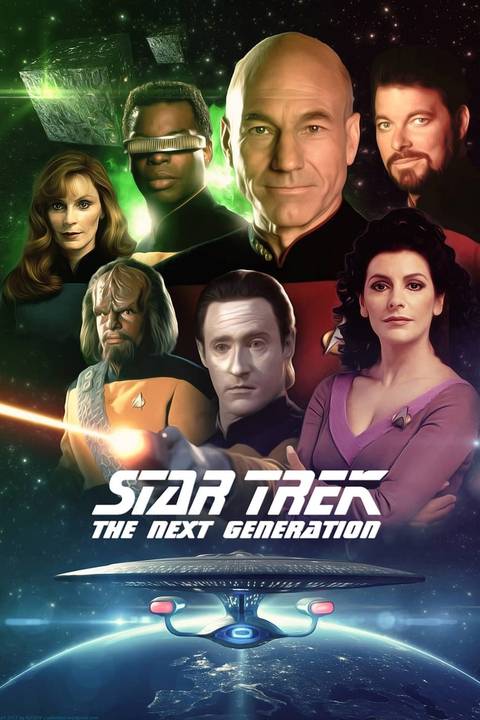
Star Trek: The Next Generation
- Release Date
-
1987 – 1994-00-00
- Network
-
Syndication
- Showrunner
-
Gene Roddenberry
- Directors
-
Cliff Bole, Les Landau, Winrich Kolbe, Rob Bowman, Robert Scheerer, Jonathan Frakes, Robert Wiemer, Gabrielle Beaumont, Alexander Singer, David Carson, Paul Lynch, Corey Allen, Patrick Stewart, Chip Chalmers, Joseph L. Scanlan, James L. Conway, Robert Lederman, Tom Benko, Timothy Bond, Robert Legato, Adam Nimoy, Robert Becker, David Livingston, LeVar Burton