When Fallout first premiered on Prime Video, fans rejoiced. The show not only managed to capture the quirk of the franchise, but it also created characters who were easy to love. Video game adaptations are never easy; you have to find the right balance between creating a strong, singular narrative and building in a world that is already fully immersive by its very nature. After Season 1, expectations were high, but Season 2 proves that Fallout didn’t just capture lightning in a bottle once. The show’s return continues the trend of successful game adaptations, bringing in elements of Fallout: New Vegas to the screen while expanding on Season 1’s established characters without overbloating the cast. Still an entertaining romp in Season 2, Fallout embraces its roots with a dark, violent, and funny return.
What Is ‘Fallout’ Season 2 About?
Season 2 of Fallout picks up sometime after the conclusion of Season 1. Hank MacLean (Kyle MacLachlan) is still in his power armor, now arriving in Las Vegas. Trailing behind him is his daughter, Lucy (Ella Purnell), and the Ghoul (Walton Goggins). Lucy wants to bring his father to justice, while the Ghoul is continuing his search for his wife, Barb (Frances Turner), and daughter, Janey (Teagan Meredith). Meanwhile, Maximus (Aaron Moten) is back with the Brotherhood of Steel, now in a lauded position as a knight and in a new position of power beneath the Elder Cleric Quintus (Michael Cristopher). Underground, Betty (Leslie Uggams) and Steph (Annabel O’Hagan) deal with problems of their own in Vaults 33 and 32, while Norm (Moisés Arias) finds himself the new leader of a group of Vaulties.
Needless to say, the story has grown exponentially this season. For Lucy and the Ghoul, their time travelling together has not only made them grow closer, but they are both beginning to see the world from each other’s perspectives. Although the Ghoul is still prickly and clearly annoyed by Lucy’s desire to see the good in people, their partnership is the beating heart of the season. While Season 1 focused on their differences, Season 2 brings them closer and sees their similarities, for better or worse.
Meanwhile, Maximus’ role in the Brotherhood of Steel adds the most meat to his arc. While he was designated to the passenger seat while travelling with Lucy in Season 1, his role in the Brotherhood has changed him. Now in a position of power, Maximus is a far cry from the naive young man we met in the first season, but that doesn’t mean he’s completely different. Tougher, stoic, and still fully obedient to the Brotherhood, Maximus’ journey, as he begins to figure out the type of man he wants to be, is a highlight for his character.
‘Fallout’ Fans Can Watch Season 1 for Free This Month — but There’s a Catch
Season 2 comes out on in just a few weeks.
Unfortunately, while what’s happening above ground is thrilling, the story of what is happening in the Vaults is much slower. Vault 33 is struggling with resource shortages, while the new residents of Vault 32 suffer from being moved to a completely new place. Though Betty and Steph have an intriguing rivalry with each other, the character who draws the biggest focus is Reg (Rodrigo Luzzi). After failing to beat Betty in the election for Overseer, he’s gone on a bit of a power trip. It’s not that the story in the Vaults isn’t interesting, because it’s clearly building up to something big, but with the pace of the narrative in the Wasteland moving at a breakneck pace, the Vault storyline kind of falls by the wayside.
Over its eight episodes (six of which were made available to Collider to review), Season 2 — now stretched in multiple different directions — becomes a bit too disparate at times. The second half of the season still relies on exposition and struggles to balance its characters. It certainly doesn’t help that we’re travelling to new locations and meeting groups like the Legion and visiting the town of New Vegas. As the world of Fallout expands, the show could benefit from more breathing room through a higher episode count, because eight just isn’t cutting it anymore.
‘Fallout’s New Characters Stand Out, but They Aren’t the Stars of Season 2
Thankfully, the saving grace of Fallout Season 2 is that it doesn’t add too many new faces to its cast, and character dynamics are built upon rather than completely reconfigured. Normally, with a new season comes a plethora of new characters; however, Fallout largely relegates them to smaller roles or cameos. The only exception to this is the real Robert House (Justin Theroux) and a few Vault Dwellers travelling with Norm. The series is great at incorporating guest stars like Macaulay Culkin and Kumail Nanjiani, but wisely doesn’t bring either of them in as full-season characters.
The biggest highlight of Fallout still lies in its character development. Lucy, Maximus, and the Ghoul are so different from their Season 1 counterparts, but all of those changes feel earned. Particularly, Aaron Moten’s Maximus earns the biggest change, and Moten plays the character far more confidently while still embodying the inner conflict that is unique to the character. While both Lucy and the Ghoul benefit from sharing scenes with each other rather than travelling alone, Maximus can hold a scene down just fine on his own.
Speaking of those other two, Lucy and the Ghoul’s little road trip across the desert has created a whole new dynamic. Ella Purnell and Walton Goggins do well playing off of each other — leaning into the contentious relationship these two characters have. In Season 1, the Ghoul assured Lucy that one day she would turn into a person like him, and that transformation has never been more obvious than in Season 2. As Lucy journeys across the Wasteland, that innocent, happy-go-lucky version of her slowly fades with each violent encounter. On the flip side, the Ghoul, who always appears hardened and cold-blooded, slowly reveals more of the man that he once was.
Beyond the main trio and the new faces, Kyle MacLachlan’s Hank takes a sharp turn this season. While in Season 1, it wasn’t truly clear where Hank fell on the spectrum of hero to villain, Season 2 sees him fully leaning into the latter. Although he’s become somewhat of a one-dimensional villain, that’s not necessarily a bad thing, and despite his actions, there’s a method to his madness that makes it hard to write him off as purely evil. In that same vein, Justin Theroux’s Robert House feels completely calculating and manipulative. His presence oozes villainy, and the series doesn’t hesitate to point out that this is a man who doesn’t seem to have the same moral boundaries that viewers do. While he’s used sparingly in the season,Theroux lights up his scenes without devolving into camp and remains a chilling villain for our beloved characters to encounter.
‘Fallout’ Has the Potential To Grow Exponentially After Season 2
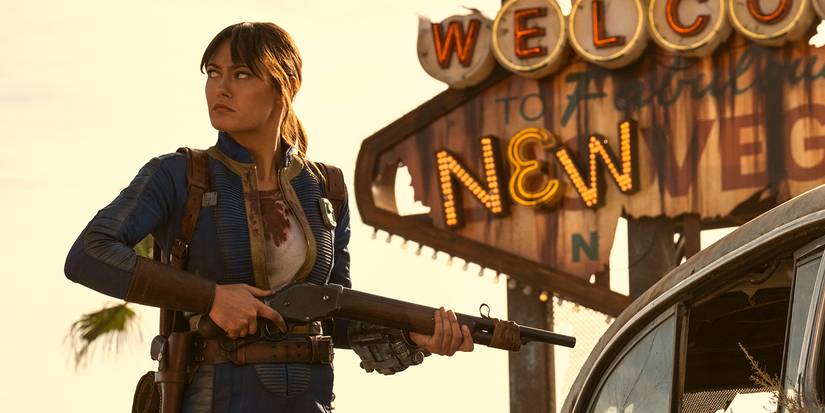
One thing is clear when watching Fallout Season 2: the world is so massive that it lends itself to a show that could go on for multiple seasons. As the story sets up multiple conflicts, Season 1 now looks like merely the exposition to a larger tale. Similar to how easy it is to sink 50 hours into an open-world game, it feels like we’ve merely dipped our toe in the universe of the show. With its impressive set design — the production and costuming have only upped the ante this season — and pitch-perfect soundtrack, Fallout Season 2 feels properly immersive. We get to see creatures like the radscorpions and deathclaws, which will make game lovers happy without diluting the core themes of the series that make it feel so rich.
In fact, it would be easy for Fallout to rely solely on the spectacle of its world, but it very seamlessly braids the inner turmoil that these characters are experiencing with the unbridled chaos of the post-apocalypse. Season 2 boasts standout scenes like a fateful and devastating face-off between Cooper Howard and Robert House as well as a sequence where a drugged-out Lucy turns into a trigger-happy, Ghoul-killing machine. The series still strikes a perfect balance between its quirky and comedic elements and the more serious story beats, keeping the story chugging along without a moment of lagging.
Combining elements of action and adventure alongside darker themes of power and control feels like a feat similar to balancing a bunch of spinning plates, but Fallout Season 2 has made it work without them dropping (at least in the first six episodes). As the season gears up toward an explosive finale, Fallout has more than proven that the show isn’t a one-hit wonder. What made Season 1 so good wasn’t a fluke at all; it was a proof of concept and a promise of a wholly unique sci-fi series that has no equal.
- Release Date
-
April 10, 2024
- Showrunner
-
Lisa Joy, Jonathan Nolan
- Writers
-
Lisa Joy, Jonathan Nolan
- Franchise(s)
-
Fallout
- Season 2 builds on existing characters flawlessly, offering deeper character development without diluting the cast with too many new faces..
- Although there’s a lot to juggle with multiple plotlines, the pacing of the season works to keep the story flowing seamlessly.
- Once again, the production design of the show, from the set to the costumes, makes the entire world completely immersive.
- While the plots in the Wasteland are the highlight, the story in the Vaults drags down the season.
- The episode count isn’t high enough for Season 2’s complicated storylines.