John Ford is an almost mythic figure from Hollywood’s “Golden Age,” and here are his best movies currently streaming on Prime Video. The John Ford/John Wayne collaborations remain some of the most acclaimed works in either man’s filmography, with The Searchers being considered one of the best Westerns ever produced.
Outside of Ford’s work with Wayne, he explored a wide range of genres throughout his career. There are John Ford war movies (They Were Expendable), award-winning dramas (The Grapes of Wrath), romantic comedies (The Quiet Man), and just about everything in between. Ford also nabbed four Academy Awards for Best Director during his career.
Ford was also a workhorse, with rarely a year going by without the director having a new movie coming out. Like Wayne, Ford started out making cheapie Westerns that he was able to elevate through sheer talent, before moving into bigger budget features.
It’s also hard to undersell how important Ford is to cinema in general. Ford was a major inspiration on other directors like Steven Spielberg, George Lucas, Akira Kurosawa and countless others, with the likes of The Grapes of Wrath or The Searchers being counted among the best American films ever.
Arrowsmith (1931)
Arrowsmith was one of Ford’s earliest movies and was based on the 1925 novel of the same name. It cast Ronald Colman in the title role, with Arrowsmith being a promising young physician whose research into a cure for the bubonic plague takes him on a life-altering trip to the West Indies to test if it works.
By all accounts, Arrowsmith is a disappointingly condensed and simplified version of the source material. Regardless, the movie was showered with award recognition, with the story exploring the various moral complexities its lead character faces despite his noble goals.
It’s also notable for the character of Dr. Marchand, played by Clarence Brooks. Marchand is regarded as one of (if not the first) instances of a Black character defying Hollywood stereotypes of the era, with Marchand being portrayed with dignity and intelligence.
Arrowsmith has dated in many ways, even regarding certain racial stereotypes, and can fall into melodrama too easily. Still, it’s a fascinating early work from Ford, and one that saw him finding his voice as a filmmaker.
Judge Priest (1934)

Another early hit from Ford, Judge Priest is a low-key comedy-drama set in a small town in the late 19th century. The story centers on Will Rogers’ Judge William Priest, who takes an empathetic approach to resolving legal disputes, and the movie was praised for its nostalgic and warm tone.
Judge Priest star Will Rogers was tragically killed in an accident in 1935, just a year after the movie’s release.
Much of that comes down to Rogers himself, who is a very endearing and kind presence. There’s much to enjoy about Judge Priest’s episodic and somewhat laidback tone, though it has to be said that despite dealing with complex issues like the aftermath of the Civil War, the movie’s use of racial stereotypes has not aged gracefully.
Even accepting that such depictions are “of their time,” it can make for rough viewing in 2025. For those willing to overlook Judge Priest’s faults, it’s anchored by some great performances and Ford’s assured hand behind the camera.
The Hurricane (1937)

An early entry in the disaster movie genre, The Hurricane follows a Polynesian soldier who is unfairly imprisoned after defending himself from a racist attacker. The story then follows Terangi’s (Jon Hall) efforts to escape captivity and make his way back to his family. Needless to say, it’s not an easy journey.
The Hurricane is best remembered now for its climactic sequence, where a violent storm ravages an island. Nearly 90 years on, this is still a technically impressive, intense setpiece, and one that comes with potent symbolism. In essence, this act of nature washes away the Colonial oppression and efforts to control the island’s natives.
It’s also another John Ford epic that looks at thorny issues like institutional racism and the nature of justice itself. This is all wrapped inside a thrilling adventure, and it has slight shades of survival movies like First Blood as Terangi breaks free of his wrongful imprisonment.
Viewed through modern eyes, The Hurricane has some stilted dialogue and it could use some tightening but it’s an underrated gem from Ford’s career. The film is often outshone by Ford’s later work, but it’s a good way to spend almost two hours.
Stagecoach (1939)
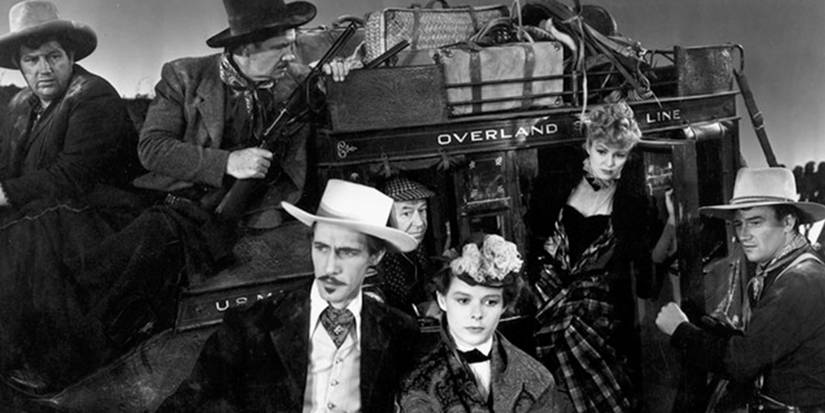
John Wayne’s introduction in Stagecoach made him a star, and he always acknowledged that Ford’s ensemble Western changed his life. The film itself follows a diverse group of characters traveling together in the titular stagecoach, which picks up Wayne’s outlaw, the Ringo Kid, along the way.
Wayne, bellowing “Hold it!” while cocking his lever-action rifle as Ford’s camera zooms in, is right up there with the best character intros of all time. While Wayne pretty much takes over Stagecoach from that moment, that’s not to say it’s his movie alone. In fact, it’s the ensemble nature of Stagecoach that makes it special.
The claustrophobic setting allows the story to focus on its characters over the plot, and gives audiences time to get to know them before the showstopping Apache raid. This sequence brings out the true colors of its cast of characters, with some rising to the occasion and others… not so much.
Stagecoach’s big action sequence is still a masterclass and feels oddly modern in its pacing and editing choices. While the rear-screen projection work is blatantly obvious now, the death-defying stunts it features are truly breathtaking. Ford also photographs Monument Valley like no other director before or since.
What Stagecoach really did for the genre moving forward was to elevate Westerns to a new level. The movie isn’t about heroes defeating villains or cowboys saving damsels in distress; it’s a story about a mismatched group of characters – each with their own backstories and motives – being forced to work together.
It’s basically a metaphor for the settling of America, not that John Ford would ever confess to such an intellectual reading. Western fans are practically duty bound to watch Stagecoach at least once, if only to see the movie where everything clicked into place for John Wayne after a decade of fronting cheapie B-movies.