Film noir isn’t just about shadows, cigarette smoke, and moral ambiguity — it’s all about faces. This iconic genre lives and dies in how someone lights a match, delivers a line like a confession, or looks at the person who’s about to ruin them. Thus, the best noir performances don’t just play characters; they define archetypes.
From doomed lovers and femme fatales to cynical detectives and men circling the moral drain, these performances shaped a genre that still echoes through every rain-slicked thriller today. Here are the ten greatest noir performances of all time, from golden age classics to the neon-lit despair of neo-noir, ranked based on their individual accomplishments, contribution to their respective movies, and impact and influence on the overall genre.
10
Kathleen Turner — ‘Body Heat’ (1981)
Kathleen Turner didn’t just play a femme fatale — she resurrected her. In Body Heat, she embodies Matty Walker with the kind of control that makes every man in the room underestimate her until it’s too late. She isn’t mysterious in the way classic noir women often are; she’s deliberate. Her danger doesn’t come from what she hides; it comes from what she wants and how ruthlessly she’ll get it.
Turner’s performance threads sensuality through sharp intellect, twisting the genre’s archetype into something new for the 1980s. The camera loves her, but it never feels like she’s merely an object of desire. Turner makes Matty the sun around which everyone else burns, and in doing so, she bridges the smoky shadows of golden-age noir with the heat of neo-noir’s revival. Simply put: she made the femme fatale terrifying again.
9
Robert De Niro — ‘Taxi Driver’ (1976)

If film noir is about men coming apart in the dark, then Travis Bickle is its ultimate unraveling. Robert De Niro gives one of the most dangerous performances of his career in Taxi Driver, inhabiting Travis not as a villain or hero but as something far more unstable. He’s lonely, self-mythologizing, violent, and heartbreakingly human. His nocturnal wanderings through New York City are pure noir — a descent into moral chaos framed as self-righteous clarity.
The iconic “You talkin’ to me?” isn’t just bravado, but rather the sound of a man trying to convince himself that the world owes him something. De Niro doesn’t romanticize Travis; he exposes him like an open, bleeding wound, slowly contaminating himself and those around him. In doing so, De Niro drags noir into the modern age, replacing trench coats and smoky blinds with sweat, blood, and neon.
8
Burt Lancaster — ‘The Killers’ (1946)

Burt Lancaster’s film debut in The Killers is a masterclass in fatalism. As “The Swede,” Lancaster plays a man who knows his ending long before it arrives. His performance is quiet, stoic, and bruised — the embodiment of a noir protagonist walking toward his doom with both eyes open and firm, precise steps.
Unlike some of noir’s sharper antiheroes, The Swede isn’t manipulative or morally gray; he’s simply broken. His choices are rooted in longing and weakness, and Lancaster plays them with a tragic stillness that lingers. When the killers arrive, it isn’t a surprise; it’s the inevitable. That resignation is what makes his performance so haunting. It became the template for the doomed noir man, someone who mistakes desire for destiny and pays the price.
7
Gloria Grahame — ‘The Big Heat’ (1953)

Gloria Grahame’s Debby Marsh is one of the most unforgettable women in noir. She’s playful, flirtatious, and vulnerable, but beneath that soft exterior is a spine of steel. In The Big Heat, Grahame refuses to let Debby be reduced to either a victim or a vixen. She navigates a violent, male-dominated world with her own set of rules, and ultimately turns the story on its head.
One of noir’s most shocking and infamous moments involves her, but what makes the performance remarkable is how she responds to it: not with melodrama, but with a quiet, searing rage. Grahame plays Debby like someone who has learned how to smile in the face of cruelty, and when she strikes back, it lands like a thunderclap. In a genre packed with femme fatales, Debby Marsh stands out as something rarer — a woman who refuses to be erased.
6
Robert Mitchum — ‘Out of the Past’ (1947)

In Out of the Past, Robert Mitchum defined noir cool. His Jeff Bailey drifts through the story like smoke: smooth, laconic, and already resigned to whatever ending is waiting for him. Mitchum’s performance isn’t showy; it’s effortless. That’s the key. He gives the sense of a man who has already played out every angle in his head and knows none of them end well.
When Jane Greer’s Kathie walks back into his life, his face barely moves, but everything changes. The way he delivers lines — dry, understated, tinged with bitterness — became the template for generations of stoic, detached noir antiheroes. Mitchum doesn’t need theatrics to sell Jeff’s tragedy; instead, all it takes is a cigarette, a shadow, and that voice. Out of the Past is film noir at its most elemental, and Mitchum is the engine that powers it.
5
Jack Nicholson — ‘Chinatown’ (1974)

Jack Nicholson’s J.J. Gittes is a noir detective trapped in a world too rotten to save. In Chinatown, Nicholson takes the cool, hardboiled archetype and cracks it open, exposing the man inside. His performance is swaggering and sharp, yes, but it’s also layered with mounting dread — the slow realization that he’s out of his depth.
Nicholson plays Gittes like a man trying to impose logic on a world that’s moved far past it, and that’s what makes it heartbreaking. When the truth finally hits, it isn’t just plot, it’s personal devastation. Nicholson’s performance is the bridge between classic noir and modern storytelling: witty, charismatic, and ultimately crushed beneath the weight of forces too powerful to fight. If noir is about losing control, no one loses it with more bruised charisma than Nicholson.
4
Gloria Swanson — ‘Sunset Boulevard’ (1950)
Gloria Swanson’s Norma Desmond is the ghost haunting all of Hollywood. In the seminal noir satire Sunset Boulevard, Swanson gives a performance that walks the line between gothic horror and classic noir, embodying fame as a kind of madness. Norma is a woman trapped in her own legend, decaying in a mansion of memories while the world forgets her.
Swanson plays her with theatrical grandeur that somehow never tips into parody. Every line drips with delusion and heartbreak, her expressions veering from goddess to ghoul in a single blink. An icon of silent cinema in her own right, Swanson transforms vanity into vulnerability, obsession into tragedy, and Hollywood’s golden glow into shadow. It’s one of cinema’s great self-critiques, and one of noir’s most devastating performances.
3
Barbara Stanwyck & Fred MacMurray — ‘Double Indemnity’ (1944)
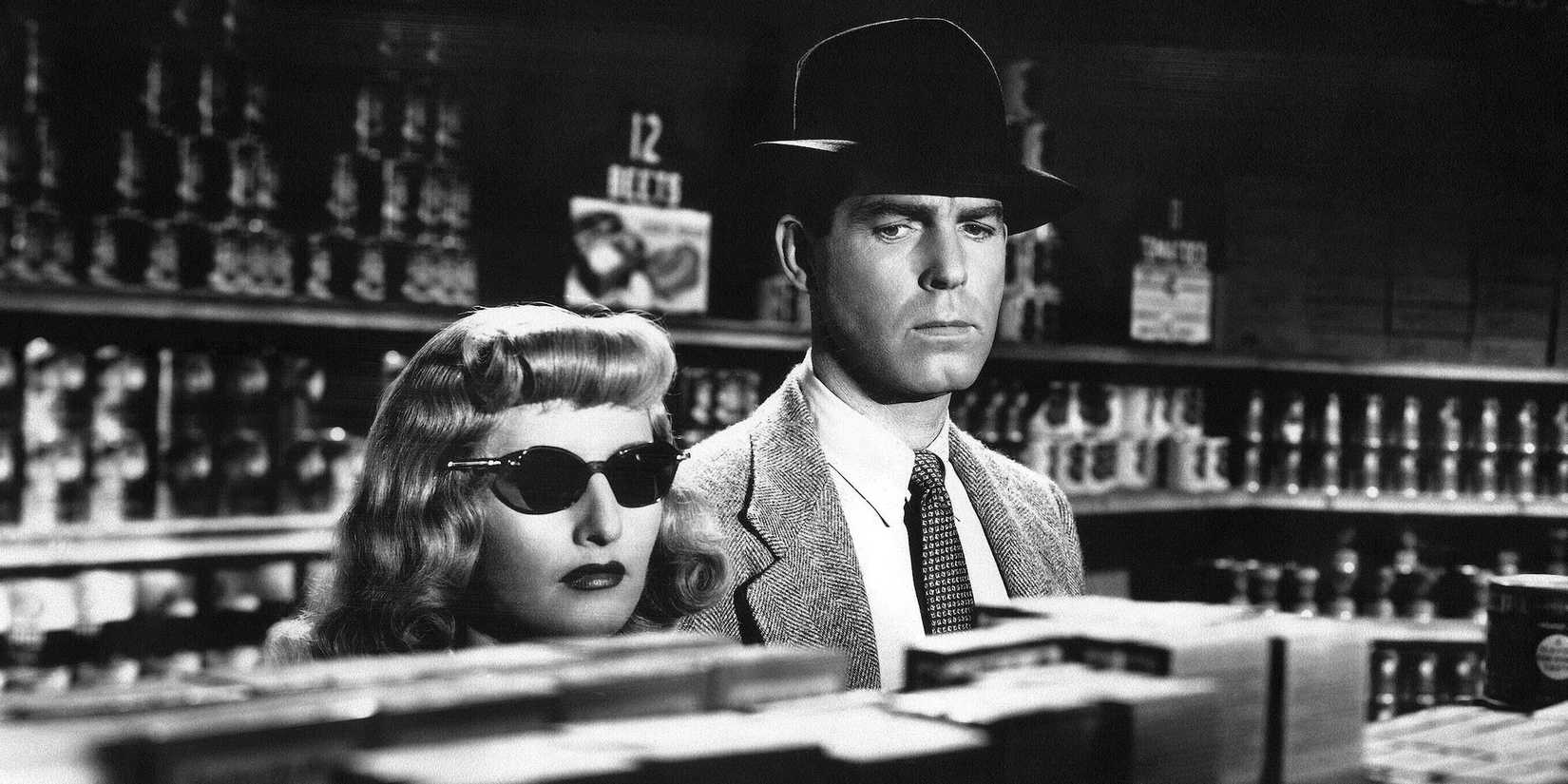
Double Indemnity is the film that wrote noir’s rulebook, and it did so through two electric performances. Barbara Stanwyck’s Phylis Dietrichson is the defining femme fatale: elegant, cunning, and utterly lethal. Her charm is a trap, and every man who steps into it thinks he’s the one who’ll outsmart her. In one movie, Stanwyck created an archetype that came to define noir’s very essence, and she made it look effortless.
Fred MacMurray’s Walter Neff, meanwhile, is the perfect fool. He believes he’s orchestrating the con until he realizes he’s been playing her game all along. What makes both performances so iconic is their chemistry. Every glance is a battle, every line a move in a chess game where only one of them knows the ending. Stanwyck and MacMurray didn’t just act in a noir; they became its blueprint.
2
Rita Hayworth — ‘Gilda’ (1946)

Rita Hayworth doesn’t just star in Gilda — she commands it. Her performance as the titular bombshell is a firestorm of sensuality, anger, and wounded pride. Hayworth understands that a femme fatale isn’t dangerous just because men desire her; she’s dangerous because she knows it. Her hair flip alone could bring down kingdoms.
But Hayworth also infuses Gilda with a startling emotional core. Beneath the smirk is someone cornered, furious at being turned into an idea rather than a person. That complexity — the push and pull between power and vulnerability — is what made Gilda — the movie and the character — legendary. Hayworth didn’t just embody the femme fatale; she made her human. It’s a performance that outlasted the film itself, echoing through noir for decades to come.
1
Orson Welles — ‘Touch of Evil’ (1958)

Hank Quinlan isn’t a man — he’s a force. In Touch of Evil, Orson Welles plays the corrupt cop with such weight and menace that he seems carved out of the rot he represents. Quinlan isn’t charming, or suave, or tragic in the traditional noir sense. He’s swollen with power and decay, a brilliant man who has long since traded morality for control.
Welles gives him the gravity of a black hole; every other character orbits his corruption. His rasping voice, physicality, and cruel intelligence make him both monstrous and deeply believable. This movie, and Welles’ performance in it, is noir at its most uncompromising: not just a man falling into darkness, but one who’s already been there too long to climb out. Welles doesn’t just give a great noir performance — he gives one of the all-time greatest performances, period.