Marvel has offered some wild twists on Spider-Man’slegendary origin story over the years, and these are just a few of the most stand-out examples. It is a testament to the power of Peter Parker’s superhero origin that it has led to so many alternative interpretations and dramatic reinventions over the years.
In the classic account, Peter is bitten by a radioactive spider, and uses the powers he develops carelessly, until he inadvertently causes his Uncle Ben’s death, learning the iconic “great power = great responsibility” lesson in the process.
This tale has been reiterated in too many ways to count; the examples listed here just scratch the surface of Spidey’s many origin changes.
“Celebrity Spider-Man”
What If? #19, Written By Peter Gillis; Art By Pat Broderick; Released In 1979
This early Marvel “What If?” story picked up on a key thread from Spider-Man’s origin story: that Peter Parker’s first impulse wasn’t to become a superhero, but rather to make money with his powers. While a radioactive spider bite empowered Peter, his true heroic origin stems from the death of Uncle Ben, and the horrifying knowledge that he could have prevented it.
Ironically, in this story, Peter does apprehend the burglar that would later kill his uncle, yet this effortless, almost-casual act of heroism sets him on the path to stardom as a stunt performer, rather than as a hero. By the end, What If #19 teaches Spider-Man the iconic “great responsibility” lesson, albeit in a roundabout way.
“Powerless Peter Parker”
Powerless #1-6, Written By Matt Cherniss And Peter Johnson; Art By Michael Gaydos; Released In 2004-2005

Powerless is one of the most unique series ever produced by Marvel Comics. As the title suggests, it depicts a version of the Marvel Universe with all of its familiar characters, but none of them have superpowers. Of course, as Marvel’s most recognizable character, the man who would’ve been Spider-Man, Peter Parker, was central to the story.
Powerless makes a crucial choice with Peter, by having the fateful spider bite still take place, and still have a tangible impact on him. Except instead of granting him superhuman abilities, the radioactive spider’s venom causes his arm to wither. It becomes a physical trait that defines him, until he overcomes it late in the story.
What this story set out to do, and did successfully in Peter’s case, is highlight that Marvel’s heroes are such strong, dynamic characters that they are still exciting even without their powers. Peter’s memorable character arc in Powerless emphasized the resonant qualities instilled in him from the very beginning, which are the true bedrock of his popularity.
“Spider-Man Sans Aunt May”
What If? #46, Written By Peter Gillis; Art By Ron Frenz; Released In 1984

On its surface, this is another “What if Uncle Ben had lived?” story, but really, it asks, “What if Aunt May had died instead?” As it turned out, the answer proved to be somewhat controversial among fans, because it seemed to conclude that Peter Parker would have been better off, something that didn’t exactly sit right with readers.
It’s not just that Aunt May has always been overtly used as a plot device to make Peter’s double life as Spider-Man harder, it is that Peter seemed to get over May’s death way quicker than Ben’s, considering the profound impact his Uncle’s demise had on him. This rightly bothered Spider-fans, making it one of the less well-received “What If?” issues of its day.
“Techno-Arachno Peter Parker”
What If? #76, Written By Terry Austin; Art By Suart Immonen; Released In 1995

This What If? issue is more fondly recalled than the prior entry; it’s story offers another exploration of the “What if Peter Parker didn’t get superpowers?” premise, with the novelty of his antagonist in the issue being a version of Spider-Man. Here, Peter compensates for his lack of powers using his aptitude for technology, crafting an Arachno suit that he uses to battle “the Spider.”
The suit’s memorable design made for an unexpected spin on Peter Parker’s heroic identity, especially considering its parallels to iconic villain Doc Ock. Peter’s eventual defeat of his rival Flash Thompson, who dons the traditional Spider-suit, once again showcased his heroic qualities stemming from his personality, rather than his Spider-powers.
“Man-Spider”
Various Incarnations Have Terrorized The Marvel Multiverse Over The Years
There have been well over a dozen versions of Man-Spider in his own right, stretching back to the 1970s. These versions of Peter Parker are all rooted in the same body horror concept: what if Peter’s mutation hadn’t stopped with enhanced senses? What if it continued to turn him into a giant spider, akin to Jeff Goldblum’s transformation in The Fly?
At its core, Spider-Man’s origin story is a fantasy. It imagines the best case scenario resulting from a traumatic situation, like being bitten by a radioactive spider. Man-Spider is the end result of exploring the horrific flip side of that, the stuff of B-movie nightmares. And in the creature’s various incarnations, it has rarely failed to deliver on this grotesque premise.
Peter Parker’s Man-Spider transformation happens quickly in some interpretations, while coming on more slowly in others. Occasionally, Man-Spider can still be heroic, but more often than not, Peter’s humanity succumbs to the beastial side of his new nature. In any case, the core idea is the same: the mainstream Marvel version of Peter Parker is very, very lucky.
“Spiders-Man”
Debut: Spider-Geddon #3, Written By Christos Gage Art By Carlo Barbari And Todd Nauck; Released In 2018
Like Man-Spider, Spiders-Man puts a body horror twist on the very foundation of the Webslinger’s character, except it takes it to an even more disturbing place. As a character, Man-Spider is rooted in the idea of Peter Parker losing his humanity to his mutation. With Spiders-Man, Peter ceases to exist, and his identity is instead taken up by a mass of sentient spiders.
Rather than being bitten by a single radioactive spider, this version of Peter is devoured completely. The arachnids that consumed him subsequently form into an approximation of the young human, setting up one of Marvel Comics’ wildest identity crisis storylines. It is an elevation of the “man vs. beast” arc made famous by Man-Spider.
In other words, what makes Spiders-Man one of the Multiverse’s most fascinating Spider-Man variants is the character’s struggle to be human, and to be a hero, rather than succumbing to its predatory insect impulses. Once more, it also throws into sharp relief that Peter Parker’s humanity is as vital as his spider-enhanced abilities.
“Ultimate Spider-Man 2.0”
Debut: Ultimate Invasion #1, Written By Jonathan Hickman; Art By Bryan Hitch; Released In 2023
The second incarnation of the Ultimate Marvel Universe proceeds from the idea, “What if someone messed with the origins of Marvel’s heroes?” In this case, the Maker, a holdover from the first Ultimate timeline, stepped in and stopped the spider from biting teenage Peter Parker. Only through the intervention of a time-traveling Tony Stark did Ultimate Peter wind up gaining his superpowers.
Marvel has devoted so much time and energy to keeping Peter Parker young that the idea of an adult Spider-Man, married to Mary Jane and raising two kids, struck readers like a major twist. Really, it is the version of the character fans have wanted for decades now, and the Ultimate Spider-Man series has largely delivered.
The wonderous thing about Marvel superheroes is that they are ordinary people endowed with extraordinary abilities. Spider-Man shows the charm of having this happen to young characters, but this twist on his iconic origin highlights that it can be just as appealing with older, more mature characters as well, another sign that Spider-Man’s origin is timeless.
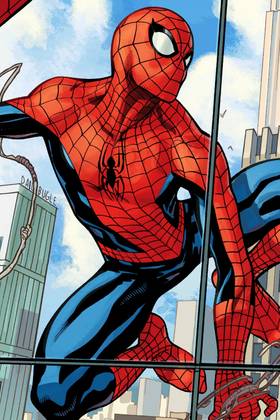
- First Appearance
-
Amazing Fantasy
- Alias
-
Peter Parker, Ben Reilly, Otto Octavius, Yu Komori, Kaine Parker, Pavitr Prabhakar, William Braddock, Miles Morales, Kurt Wagner
- Alliance
-
Avengers, Fantastic Four, X-Men, Secret Defenders, Future Foundation, Heroes for Hire, Mighty Avengers, New Avengers, Web-Warriors
- Race
-
Human